
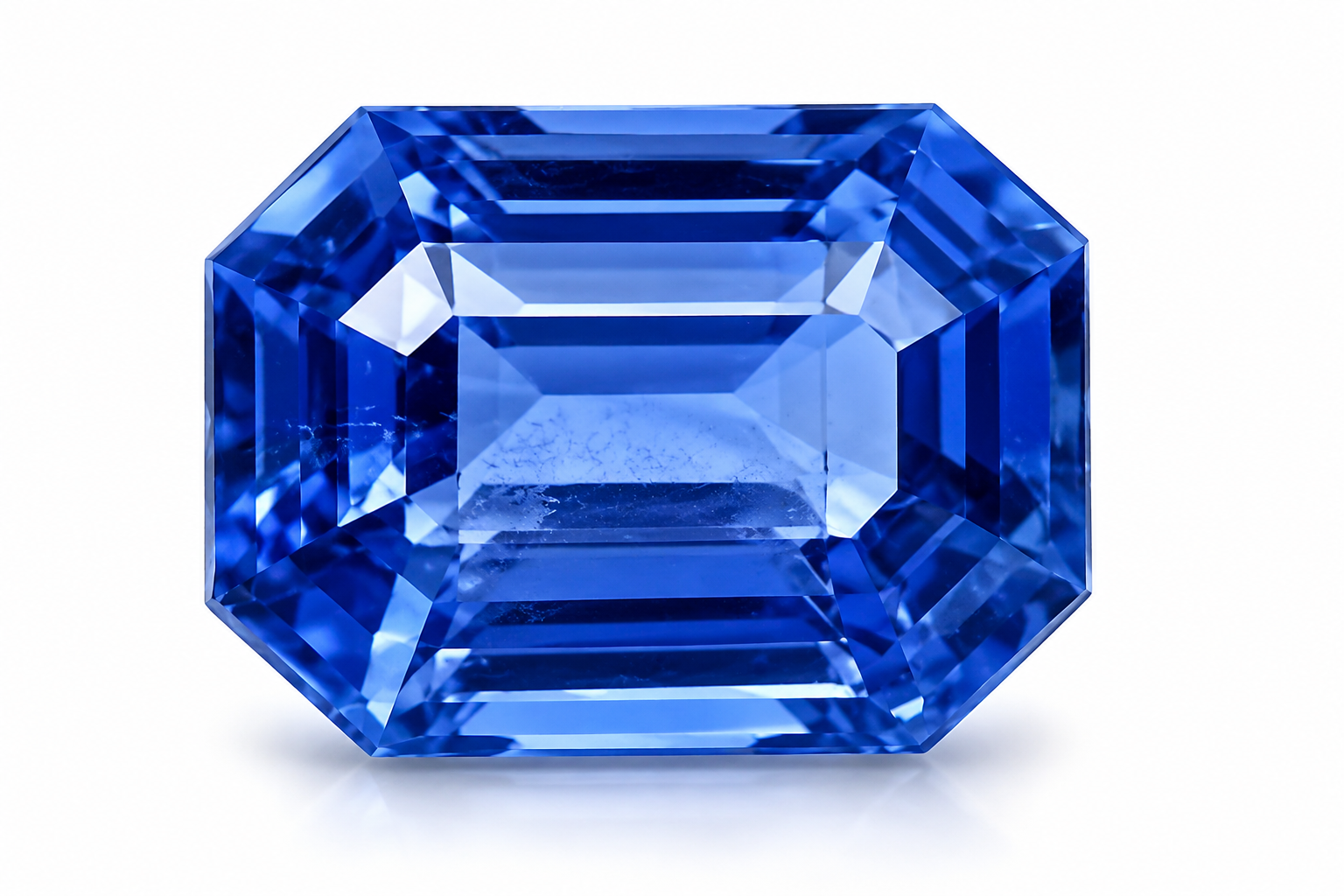
Natural blue sapphires are among the world's most admired coloured gemstones. Some are sold in their naturally occurring condition, while others undergo controlled heating to improve their colour or clarity.
Both can be beautiful, valuable natural gemstones. However, their treatment history can make a meaningful difference to rarity, desirability, pricing and collectability.
At Shri Hari Gems & Jewels, we believe buyers should understand not only how a sapphire looks, but also what has happened to it before it reaches them.
In this guide, we explain the gemological differences between heated and unheated sapphires, how laboratories identify treatment, why natural no-heat blue sapphires are comparatively rare, and what buyers should consider before purchasing.
1. What Is a Natural Unheated Sapphire?
An unheated sapphire is a natural corundum gemstone for which a gemological laboratory has found no indications of heat treatment intended to modify its colour or transparency.
Sapphires form naturally within the Earth under geological conditions involving temperature, pressure and the presence of particular chemical elements.
Their colour and appearance depend on several factors, including trace elements, geological environment, internal inclusions and crystal growth.
A natural unheated blue sapphire retains its naturally developed characteristics without detectable evidence of artificial heat enhancement.
These stones can be particularly desirable when they possess:
- Attractive, well-balanced blue colour.
- Strong or vivid saturation without excessive darkness.
- Good transparency.
- Attractive clarity and natural internal characteristics.
- Fine cutting and proportions.
- Desirable size and rarity.
- A credible independent laboratory report.
**An important distinction:** Unheated does not automatically mean exceptional quality. An unheated sapphire may have pale colour, excessive inclusions or poor cutting. Its complete quality must always be evaluated.
2. What Is a Heat-Treated Sapphire?
Heat treatment is an established gemological enhancement process in which a natural sapphire is exposed to controlled high temperatures, sometimes under particular atmospheric or pressure conditions.
The purpose is to improve certain visual characteristics, especially colour and transparency.
Depending on the sapphire's original composition and internal features, heating may:
- Deepen or modify blue colour.
- Improve colour uniformity.
- Reduce the visual effect of certain inclusions.
- Dissolve or alter microscopic rutile inclusions, commonly called silk.
- Improve the gemstone's overall appearance.
Heat treatment is widely used in the coloured gemstone industry and is generally regarded as an accepted enhancement when properly disclosed.
A heat-treated sapphire remains a natural sapphire. It does not become laboratory-grown simply because it has been heated.
However, buyers should distinguish ordinary heat treatment from more complex processes involving foreign-element diffusion, flux-assisted healing or glass filling.
3. How Does Heat Treatment Change a Sapphire Internally?
This is where gemology becomes particularly interesting.
Natural blue sapphire is a variety of corundum. Its blue colour is primarily associated with interactions involving iron and titanium within the crystal structure.
Many sapphires contain microscopic rutile inclusions, commonly known as silk. These inclusions may appear as fine needle-like structures.
During certain heat-treatment processes, rutile can partially or completely dissolve into the corundum.
This changes the distribution of elements within the crystal and can influence the gemstone's colour and transparency.
A gemologist examining a sapphire may look for:
**A. Altered rutile silk**
Natural, unaltered silk may appear as fine, continuous needle-like inclusions. After heating, these can become partially dissolved, fragmented or altered.
**B. Altered mineral inclusions**
Certain mineral inclusions may show evidence of melting, reaction or other thermal alteration.
**C. Internal fractures and residues**
Heating can cause fractures to heal or change, sometimes leaving residues from materials used during the treatment process.
**D. Spectroscopic evidence**
Advanced instruments can examine the gemstone's interaction with light and identify features associated with certain treatments.
No single inclusion or spectroscopic feature should be used in isolation to determine whether a sapphire has been heated. The interpretation depends on the complete gemological evidence.
4. How Do GIA, SSEF, Gübelin and GRS Identify Unheated Sapphires?
For an important sapphire purchase, independent laboratory examination is highly valuable.
Leading laboratories use combinations of microscopic examination, spectroscopy and other analytical techniques to investigate gemstone identity, treatment and, where requested and determinable, geographic origin.
GIA – Gemological Institute of America
GIA is internationally recognised for its gemological research and laboratory services.
Its coloured gemstone reports can identify whether a sapphire is natural or laboratory-grown and provide information about detectable treatments.
A report may use the wording:
**"No indications of heating."**
This means the laboratory did not find gemological evidence indicating that the sapphire underwent heat treatment.
GIA research has documented how heat can alter rutile silk and internal inclusions, changing the appearance of a sapphire.
SSEF – Swiss Gemmological Institute
SSEF follows a full-disclosure approach to treatments detected during examination.
For sapphires, its report terminology distinguishes between:
- No indications of heating.
- Indications of heating.
- Heating accompanied by residues in healed fissures or cavities.
- Other detectable enhancement processes, including diffusion and filling.
SSEF also examines microscopic features, trace-element chemistry and spectroscopic data when providing geographic-origin opinions.
Gübelin Gem Lab
Gübelin Gem Lab is another respected Swiss gemological institution.
Its work includes the examination of natural coloured gemstones, treatments and geographic origin.
Gübelin has contributed to the development of standardised disclosure terminology for heat-treated ruby and sapphire, including the assessment of residues remaining in healed fissures.
This distinction is important because two heated sapphires may have undergone different processes and may not have the same commercial desirability.
GRS – GemResearch Swisslab
GRS provides detailed gemstone enhancement disclosures.
Its published terminology distinguishes several treatment categories, including:
- No indication of thermal treatment.
- Heating without residues.
- Heating with different quantities of residues.
- Heating with beryllium diffusion.
- Lead-glass-filled material.
- Other specialized enhancement processes.
GRS also provides additional information about certain treatment processes and their implications for the gemstone.
**Why this matters:** Buyers should read the complete treatment comments rather than simply looking for the words "heated" or "unheated".
6. What Does "No Indications of Heating" Actually Mean?
This is one of the most important questions in the sapphire trade.
When a laboratory states "No indications of heating", it is expressing a gemological conclusion based on the examination performed.
It does not mean that the laboratory has witnessed the entire geological and handling history of the gemstone.
It means that the laboratory has not identified diagnostic evidence of artificial heat treatment using its available analytical methods.
There are also sapphires whose characteristics make treatment detection particularly challenging.
In recent research published in 2026, SSEF described unheated sapphires containing unusual trace elements and microscopic mineral inclusions that displayed some features previously associated with heating.
This demonstrates why experienced laboratories must evaluate multiple lines of evidence.
For serious buyers, an independent report from a respected laboratory is preferable to a seller's verbal assurance.
7. Why Are Unheated Blue Sapphires More Valuable?
Unheated sapphires can command a premium because attractive natural colour and clarity without detectable heat enhancement are comparatively scarce.
However, the premium is not fixed and does not apply equally to every gemstone.
The commercial desirability of an unheated sapphire depends on several factors.
1. Natural colour
A sapphire with beautiful, balanced blue colour and attractive saturation may be considerably more desirable than a pale or overly dark stone.
2. Clarity and transparency
Fine unheated sapphires with attractive transparency and limited distracting inclusions are particularly sought after.
3. Carat weight
Larger sapphires of fine quality are generally rarer. The price per carat may increase substantially with size, depending on the gemstone's quality.
4. Geographic origin
Certain origins are associated with particularly desirable sapphire characteristics.
Examples include:
- Sri Lanka (Ceylon).
- Kashmir.
- Myanmar (Burma).
- Madagascar.
However, origin alone does not determine value. An exceptional sapphire from one origin may be more desirable than an inferior stone from another.
5. Treatment status
An unheated sapphire of comparable quality may command a substantial premium over a heated example because of its rarity and collector demand.
6. Certification
Independent laboratory documentation helps buyers establish the gemstone's identity and treatment characteristics.
A recognised report can support confidence in a purchase, but it does not guarantee a particular market price.
9. Are All Unheated Sapphires Rare?
No. The word "unheated" alone does not establish exceptional rarity.
The market contains natural unheated sapphires across a wide range of colours, qualities and sizes.
What is particularly scarce is the combination of:
- Natural, unheated condition.
- Exceptional blue colour.
- Strong and attractive saturation.
- Good transparency.
- Fine clarity.
- Desirable cutting.
- Significant carat weight.
- Credible origin documentation, where available.
For example, a large, transparent, beautifully coloured natural unheated Sri Lankan sapphire with a respected laboratory report may attract significant interest from collectors and fine-jewellery buyers.
Its value comes from the combination of its characteristics, not simply the absence of heat treatment.
10. Does Heat Treatment Reduce the Durability of a Sapphire?
Sapphire is a very durable gemstone, with a Mohs hardness of 9.
Ordinary heat treatment does not automatically make a sapphire unsuitable for jewellery.
However, durability should not be judged by hardness alone.
The presence of fractures, cavities, glass filling, diffusion-related features and other enhancements can influence how a sapphire should be handled, repaired or set.
Glass-filled sapphires, for example, require particular care and should not be treated as equivalent to conventionally heated sapphires.
For valuable sapphire jewellery, always inform your jeweller of the treatment history before resizing, repair or exposure to high temperatures.
11. How to Buy a Natural No-Heat Blue Sapphire Responsibly
If you are considering purchasing an unheated sapphire, we recommend following these steps.
**Step 1 – Confirm natural identity**
Ensure the report identifies the gemstone as natural sapphire rather than laboratory-grown material or a simulant.
**Step 2 – Check treatment disclosure**
Look for a clear statement such as "No indications of heating" in the laboratory report.
**Step 3 – Verify the report**
Use the laboratory's official report-verification facility. Check the report number and compare the physical gemstone with the report description.
**Step 4 – Evaluate colour and clarity**
Examine the sapphire in different lighting conditions. Consider its hue, tone, saturation, transparency and visible inclusions.
**Step 5 – Understand geographic origin**
If origin is important to your purchase, request a suitable origin report from a laboratory offering that service for the gemstone in question.
Remember that geographic-origin opinions are expert conclusions, not absolute guarantees.
**Step 6 – Compare prices fairly**
Compare sapphires with similar quality, weight, treatment status and documented origin. Do not compare solely on carat weight.
**Step 7 – Ask for full disclosure**
Request written information about treatment, certification, return conditions and the seller's product description.
12. Why Choose Shri Hari Gems & Jewels for Natural Sapphires?
At Shri Hari Gems & Jewels, we understand that a fine sapphire is more than its weight or colour.
It represents geological rarity, natural beauty and the craftsmanship required to transform an exceptional gemstone into a treasured possession.
Our collection includes natural coloured gemstones, with a focus on sapphires, emeralds, rubies and other precious varieties.
We value transparent disclosure and independent gemological documentation. Where applicable, our gemstones are accompanied by reports from recognised laboratories such as GIA and IGI.
For customers seeking natural no-heat blue sapphires, we encourage a careful evaluation of:
- Natural identity.
- Treatment status.
- Colour and transparency.
- Clarity and cut.
- Carat weight.
- Geographic origin, where documented.
- Independent laboratory certification.
Whether you are a gemstone collector, jewellery designer or buyer looking for an exceptional sapphire engagement ring, our team can help you explore suitable options.
**Our philosophy is simple: exceptional gemstones deserve honest descriptions, informed buyers and lasting trust.**
Frequently Asked Questions
1. What is an unheated sapphire?
An unheated sapphire is a natural sapphire for which a gemological laboratory has found no indications of artificial heat treatment to modify its colour or transparency.
2. Is an unheated sapphire more valuable than a heated sapphire?
Often, when comparing stones of similar quality, an unheated sapphire may command a premium because fine natural examples are comparatively scarce. However, colour, clarity, size, origin and market demand remain important.
3. How can I identify an unheated blue sapphire?
Visual inspection alone is not reliable. A qualified gemologist and an independent laboratory using appropriate analytical methods should examine the gemstone.
4. What does "No indications of heating" mean on a GIA or SSEF report?
It means that the laboratory did not detect gemological evidence of heat treatment during its examination. It is not an absolute statement about every event in the gemstone's history.
5. Are Ceylon unheated sapphires valuable?
Fine-quality unheated Sri Lankan sapphires can be highly desirable. Their value depends on colour, clarity, transparency, weight, cut, treatment status and market demand.
6. Can a heated sapphire still be valuable?
Absolutely. A fine-quality heated sapphire can be a beautiful and valuable natural gemstone. Heat treatment is an accepted enhancement when accurately disclosed.
7. Is heat treatment permanent?
Conventional heat treatment generally produces permanent changes to the gemstone. However, other processes, such as certain coatings or fillings, have different stability and care requirements.
8. Can GIA or IGI confirm that a sapphire is unheated?
Both laboratories provide coloured gemstone examination services. Buyers should check the precise report wording and the scope of the service performed.
9. Does an unheated sapphire always have better colour?
No. Some heated sapphires have more vivid or uniform colour than unheated examples. Natural unheated sapphires can also have a wide range of colours and quality.
10. Which laboratory is best for an unheated sapphire?
GIA, SSEF, Gübelin and GRS are among the respected laboratories buyers may consider. The appropriate choice depends on the report services required, the gemstone and the buyer's purpose.
Discover Natural Blue Sapphires
Looking for an exceptional natural blue sapphire?
Explore the collection at Shri Hari Gems & Jewels and discover carefully selected coloured gemstones with transparent descriptions and independent gemological documentation where available.
For enquiries about natural no-heat blue sapphires, certification, origin or custom sapphire jewelry, contact our team for personalized assistance.
**Shri Hari Gems & Jewels**
*Crafted with Integrity. Treasured for Generations.*
Website: [https://shriharigemsjewels.com/](https://shriharigemsjewels.com/)