
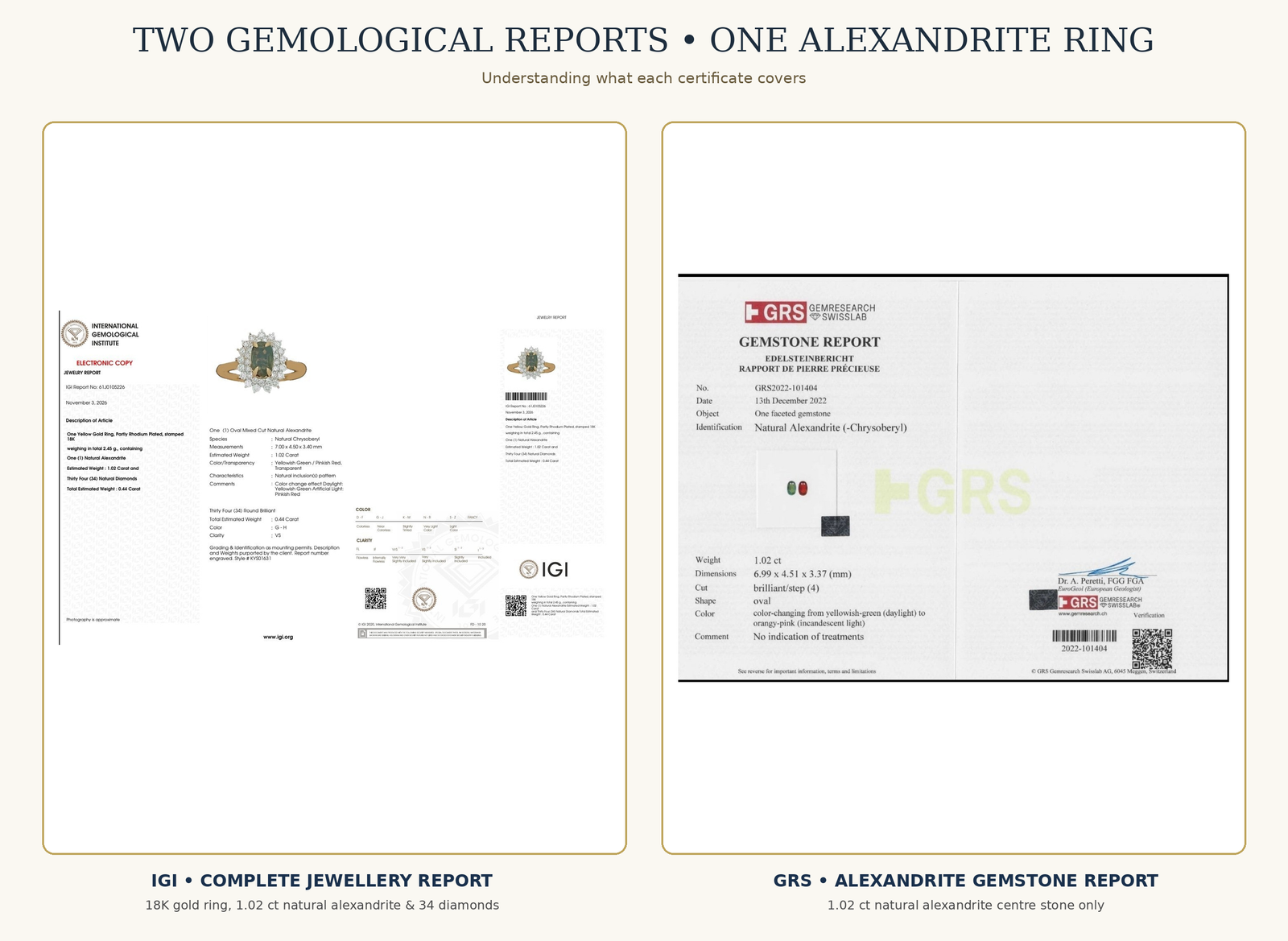
**A practical comparison of a GRS gemstone report and an IGI jewellery report, using one natural alexandrite ring as an example.**
When purchasing fine coloured gemstone jewellery, understanding the accompanying laboratory reports is an important part of making an informed decision.
A gemstone report and a jewellery report may appear similar, but they can serve different purposes. One may focus on the identity and characteristics of an individual gemstone, while another may document a complete mounted jewellery item.
An excellent example is this 18K yellow gold alexandrite ring from Shri Hari Gems & Jewels, accompanied by both a GRS gemstone report and an IGI jewellery report.
The two reports relate to the same 1.02-carat natural alexandrite centre stone, but they cover different aspects of the piece.
1. The IGI report: Certification of the complete ring
The IGI jewellery report, dated 3 November 2026, documents the complete ring.
According to the report, the jewellery item is:
- **Metal:** 18K yellow gold, partly rhodium plated
- **Total ring weight:** 2.45 grams
- **Centre gemstone:** One natural alexandrite
- **Alexandrite weight:** 1.02 carats
- **Diamond accents:** 34 natural round brilliant diamonds
- **Total estimated diamond weight:** 0.44 carat
- **Diamond colour:** G–H
- **Diamond clarity:** VS
The report also describes the alexandrite as an oval mixed-cut natural chrysoberyl, with a yellowish-green and pinkish-red colour appearance.
The important point is that the IGI report describes the mounted jewellery item, including the ring's metal, centre gemstone and diamond accents.
2. The GRS report: Examination of the alexandrite centre stone
The GRS Gemstone Report, dated 13 December 2022, focuses on the loose gemstone rather than the complete ring.
Its recorded details are:
- **Identification:** Natural Alexandrite (Chrysoberyl)
- **Weight:** 1.02 carats
- **Shape:** Oval
- **Cut:** Brilliant/step
- **Dimensions:** 6.99 × 4.51 × 3.37 mm
- **Colour change:** Yellowish-green in daylight to orangy-pink under incandescent light
- **Treatment comment:** No indication of treatments
Alexandrite is particularly valued for its colour-change phenomenon. The visible colour can change depending on the lighting conditions.
The GRS report specifically records this colour-change behaviour for the centre stone.
3. GRS vs IGI: What is the difference?
The most important distinction in this example is the scope of each report.
| Feature | IGI report | GRS report | | Report type | Jewellery report | Gemstone report | | Subject | Complete mounted ring | Alexandrite centre stone | | Metal details | 18K gold and rhodium plating recorded | Not applicable | | Centre stone | 1.02 ct natural alexandrite | 1.02 ct natural alexandrite | | Diamond details | 34 natural diamonds, estimated 0.44 ct | Not covered | | Colour-change description | Yellowish-green / pinkish-red | Yellowish-green to orangy-pink | | Treatment comment | Refer to the report's stated findings | No indication of treatments |
These reports should not be viewed as competing certificates. They document different things.
The IGI report provides information about the finished ring, while the GRS report provides detailed information about the alexandrite gemstone.
4. Why does this distinction matter when buying alexandrite jewellery?
When buying a valuable coloured gemstone ring, a customer may want to understand two separate questions:
**First: What is the centre gemstone?**
A gemstone report can provide information about the gemstone's identification, weight, dimensions, shape, colour characteristics and treatment findings.
**Second: What does the finished jewellery item contain?**
A jewellery report can document the mounted item, including its metal description, centre gemstone and accompanying diamonds, where these are covered by the report.
Understanding the scope of each report helps buyers avoid assuming that a certificate covers details it was not intended to examine.
5. Our approach to transparency at Shri Hari Gems & Jewels
At Shri Hari Gems & Jewels, we believe that trust is built through accurate product descriptions, transparent gemstone information and appropriate laboratory documentation.
For this alexandrite ring, the two reports provide complementary information:
- The GRS report documents the 1.02-carat natural alexandrite centre stone.
- The IGI report documents the complete 18K gold ring and its diamond accents.
For buyers of rare coloured gemstones and fine jewellery, understanding the report is just as important as seeing the gemstone.
**A certificate should not simply be displayed. Its scope should be understood.**
Shri Hari Gems & Jewels *Crafted with Integrity. Treasured for Generations.*
Frequently Asked Questions
Is GRS a gemstone report or a jewellery report in this example?
The supplied GRS document is a gemstone report for the 1.02-carat natural alexandrite centre stone.
Does the IGI report cover the complete ring?
Yes. The supplied IGI jewellery report describes the 18K gold ring, its 1.02-carat natural alexandrite and 34 natural diamonds.
Why are there two certificates for one ring?
They serve complementary purposes. The GRS report focuses on the alexandrite gemstone, while the IGI report documents the complete mounted jewellery item.
Does the GRS report mention alexandrite colour change?
Yes. It records a change from yellowish-green in daylight to orangy-pink under incandescent light.
Does the GRS report indicate treatment?
The supplied GRS report states: "No indication of treatments. YOU CAN FIND THE RING HERE https://shriharigemsjewels.com/products/18k-yellow-gold-natural-alexandrite-diamond-halo-ring-1-02-ct-color-chan-810